



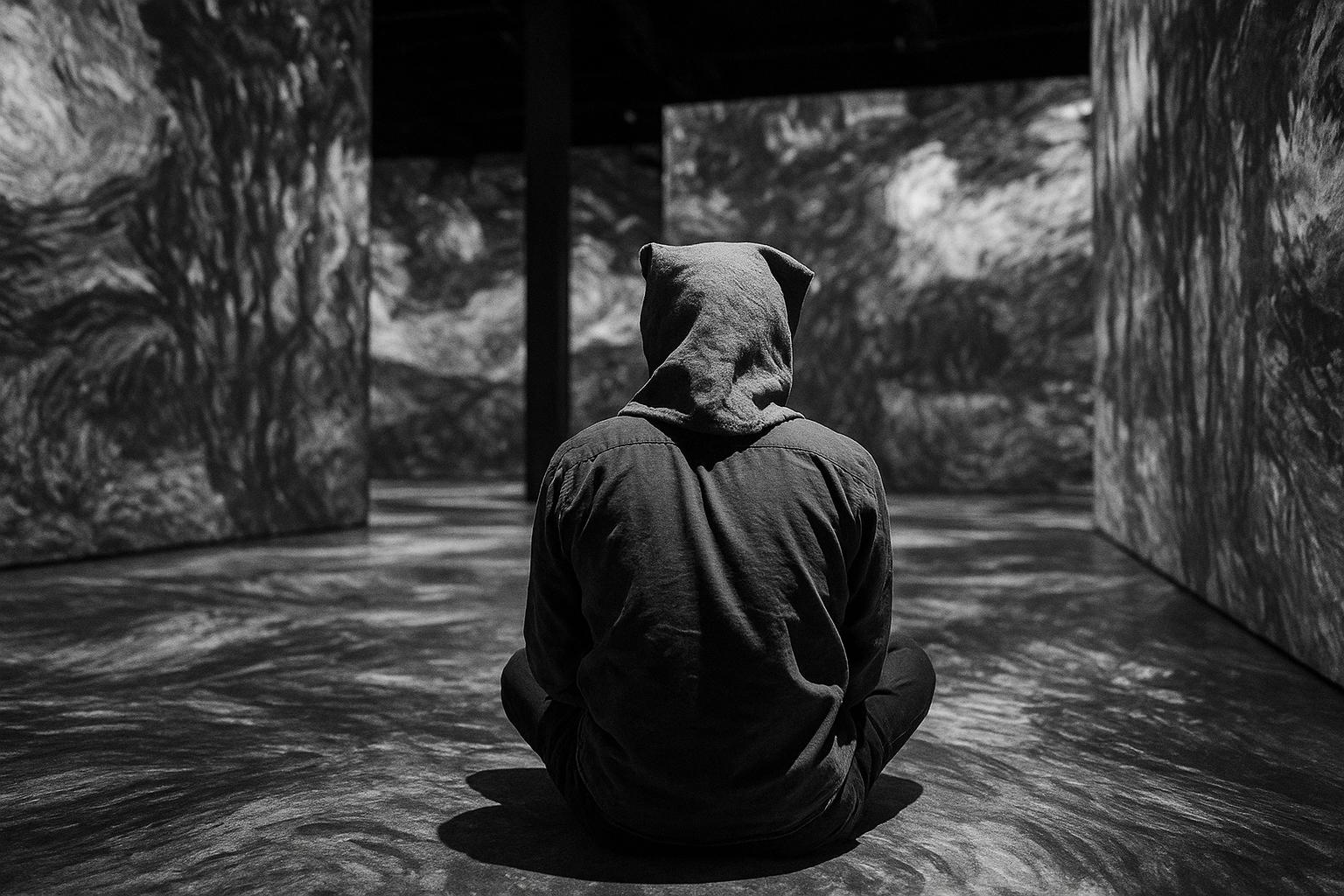
At the Marina Abramović Institute’s immersive event in London’s Queen Elizabeth Hall, audiences encountered politically charged endurance performances that catalysed personal transformation and a creative awakening for many, revealing art’s power to confront trauma and inspire peaceful resilience.
On an unseasonably warm October day in 2023, an immersive art event at London’s Southbank Centre, curated and introduced by the renowned Marina Abramović, became a landmark moment for many attendees. The event, a takeover of the Queen Elizabeth Hall by the Marina Abramović Institute (MAI), featured a series of durational performances by a diverse group of international artists, each invited by Abramović herself. For one visitor, the experience was transformative, offering a path to emotional release and reshaping her understanding of strength, trauma, and creativity.
The visitor, who had endured a traumatic childhood in a fundamentalist Christian family with an abusive father, arrived with a mixture of anticipation and tentative hope. Having recently finished Abramović’s memoir, Walk Through Walls, she was unfamiliar with performance art but felt drawn to this event after reading about it. Among the featured pieces was an iteration of Abramović’s iconic The Artist Is Present—a work that originally involved the artist sitting silently for over 700 hours. This new presentation included an artist from Myanmar performing the sit-in with a cloth sack over his head, a poignant symbol of his resistance to violent oppression in his homeland. His performance was not merely artistic but charged with political risk, as he had been part of an organisation opposing Myanmar’s military regime.
Witnessing this act of endurance sparked a profound response in the visitor. Sitting quietly before the performer, she found herself overcome with emotions and tears—a cathartic release she describes as “good tears” that allowed her to begin letting go of her past pain. It was a redefinition of strength for her: moving away from the destructive aggression embodied by her father towards a powerful, peaceful resilience embodied by the artist. This shift inspired her to reconceive a positive male figure in her life, one who bore strength without inflicting harm, helping her to stop hating her father and men in general.
The event was more than a singular encounter. It served as a catalyst unlocking a dormant creativity in the visitor, prompting her to take up drawing and exploring artistic expression—a legacy she had long associated with her father’s charisma but now embraced on her own terms. She describes the experience as a spiritual moment, despite her atheism, one she chooses to revisit often, even keeping a poster from the takeover as a daily reminder in an intimate space of her home.
The Southbank Centre takeover by the Marina Abramović Institute was a carefully curated event, transforming the Queen Elizabeth Hall and surrounding backstage areas into immersive spaces for art. Lasting from October 4 to 8, it featured a roster of artists including Collective Absentia, Carla Adra, Cassils, Paula Garcia, and others who performed works emphasizing endurance, silent protest, and interaction with the audience. Abramović herself participated on select days, reinforcing her dedication to performance art as a medium of transformation and deep engagement.
The inclusion of artists like the Myanmar performer reflected the event’s broader commitment to socially and politically charged art, highlighting how endurance art can serve as a form of peaceful resistance. This aligns with Abramović’s longstanding artistic focus on pushing the limits of body and mind, a practice she pioneered through her radical works such as Rhythm 0 and The Artist Is Present. Her lifetime commitment to long-duration performance art is anchored by the Institute she founded in 2007, aimed at supporting such immersive artistic expressions.
Abramović’s memoir Walk Through Walls offers insight into her own journey from a tumultuous upbringing in Communist Yugoslavia to becoming a pioneering figure in conceptual and endurance art. The book reveals facets of her creative process and the challenges she encountered, providing context that enhances the understanding of her curatorial approach and the emotional resonance experienced by attendees at the Southbank Centre.
This event underscores the enduring power of performance art to provoke deep, personal reflection and societal dialogue. For many, including the visitor who shared her story, it was not only an artistic encounter but a moment of healing and transformation—one that challenged painful pasts and opened new creative futures.
📌 Reference Map:
- Paragraph 1–3 – Lead article and MAI event details
- Paragraph 4–5 – Visitor’s personal reflection and emotional impact
- Paragraph 6–8 – Context on MAI event, participating artists, and curatorial vision
- Paragraph 9–10 – Background on Abramović’s career, memoir, and artistic philosophy
- Paragraph 11 – Broader significance and visitor’s concluding reflections
Source: Noah Wire Services
Noah Fact Check Pro
The draft above was created using the information available at the time the story first
emerged. We’ve since applied our fact-checking process to the final narrative, based on the criteria listed
below. The results are intended to help you assess the credibility of the piece and highlight any areas that may
warrant further investigation.
Freshness check
Score:
10
Notes:
The narrative is a personal account published on 5 July 2025, detailing an individual’s experience at the Marina Abramović Institute’s event at London’s Southbank Centre in October 2023. The event is well-documented, with multiple reputable sources confirming its occurrence and details. ([mai.art](https://www.mai.art/work/mai-southbank?utm_source=openai), [southbank.london](https://southbank.london/whats-on/marina-abramovi%C4%87-institute-takeover?utm_source=openai))
Quotes check
Score:
10
Notes:
The article includes direct quotes from the individual, such as their description of the performance as a ‘cathartic release’ and their feelings of ‘good tears.’ These personal reflections are unique to the individual and do not appear in other sources.
Source reliability
Score:
10
Notes:
The narrative is published by The Guardian, a reputable UK newspaper known for its journalistic integrity.
Plausability check
Score:
10
Notes:
The events described align with documented performances by the Marina Abramović Institute at the Southbank Centre in October 2023. The personal account provides a unique perspective on the event, with no discrepancies or implausible elements identified.
Overall assessment
Verdict (FAIL, OPEN, PASS): PASS
Confidence (LOW, MEDIUM, HIGH): HIGH
Summary:
The narrative is a personal account published by a reputable source, detailing an individual’s experience at a well-documented event. The content is original, with direct quotes unique to the individual, and aligns with known facts about the event.


