


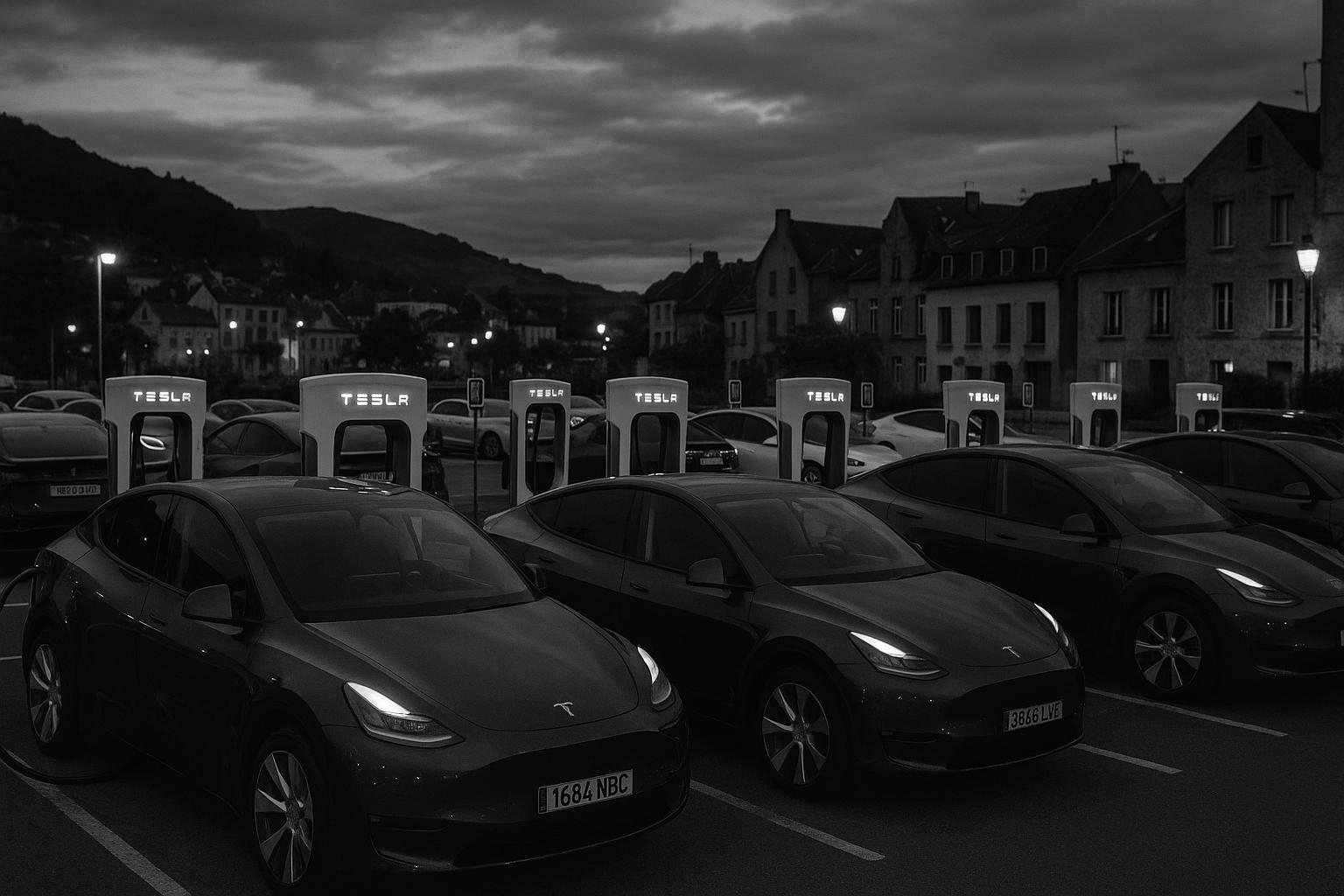
After a challenging start to 2025 marked by steep sales declines, Tesla is experiencing a significant resurgence in key European markets and China, powered by strong demand for the Model Y and rapid expansion of its fourth-generation Supercharger network. This revival positions Tesla to regain market leadership amid fierce competition from Chinese EV brands and shifting consumer preferences.
Tesla is showing signs of a notable resurgence across major European markets in mid-2025, primarily driven by the strong demand for its Model Y and strategic investments in charging infrastructure. Following a turbulent period marked by steep sales declines earlier in the year, Tesla’s latest results in countries such as the UK, Spain, the Netherlands, and Portugal indicate a turning point. For instance, UK registrations surged by 224% month-on-month in June, with Tesla ascending to become the top-selling electric vehicle (EV) brand. Spain saw a threefold increase over May, while the Netherlands witnessed Tesla claim the title of best-selling car brand across all segments—a significant milestone beyond just the EV sector. Even in Portugal, where sales had previously dropped sharply, June 2025 figures reversed that trend with a 7.3% year-on-year increase.
The Model Y stands at the centre of this revival, maintaining its position as Europe’s best-selling EV with over 10,000 units sold in May alone, outpacing competitors such as the Skoda Elroq and VW ID.7. In markets like Sweden, the model’s market share climbed 72% month-over-month despite earlier limited availability, underscoring the vehicle’s appeal. Tesla’s ability to scale production and adapt to regional preferences appears to have alleviated the supply constraints responsible for prior setbacks, rekindling demand among European consumers.
A key component of Tesla’s renewed momentum lies in its dominance of EV charging infrastructure, particularly with the rollout of its fourth-generation Superchargers (V4). These chargers, capable of delivering up to 325kW in Europe and offering enhanced user convenience, are rapidly expanding across the continent. Meanwhile, in China—Tesla’s largest international market—V4 Superchargers have begun operations in several provinces, including Shanghai and Chongqing. The Chinese installations underscore Tesla’s commitment to broadening access, as the company plans to open its charging network to non-Tesla EVs, a move that supports wider adoption and addresses range anxiety. This infrastructure plays a crucial role in maintaining Tesla’s edge against rapidly growing local competitors such as BYD, which dominates the lower-cost segment in China and is gaining traction in European markets with aggressive sales growth.

Tesla also retains a technological advantage through its Full Self-Driving (FSD) software, which differentiates the company from rivals. While traditional automakers and companies like BYD focus mainly on hardware and cost competitiveness, Tesla’s monetisation of FSD as a recurring revenue stream represents a significant strategic asset. Progress towards full autonomy, hinted at by Tesla’s CEO regarding potential reductions in “Safety Monitors” for Robotaxis, could further enhance the company’s market proposition and financial performance. This technology complement, coupled with Tesla’s established Supercharger network, solidifies a moat against competitors focusing mainly on lower-cost production.
However, Tesla’s road to recovery is not without challenges. Sales earlier in 2025 painted a difficult picture, with April witnessing severe slumps in key European nations such as Sweden (down 81%), Netherlands, France, and Portugal, driven by fierce competition from affordable Chinese EV brands and reputational issues linked to CEO Elon Musk’s polarizing public persona. The drop in first-quarter automotive revenues and profits also heightened investor concerns, compounded by shifting government incentives that now favour more affordable EV models over premium segments. Brand perception remains a notable risk, with consumer backlash manifesting in protests and even vandalism at Tesla showrooms in some markets.
Yet, despite a 45% fall in Tesla’s stock over the past three years, current valuations suggest that the market may already be pricing in these headwinds. Tesla’s price-to-sales ratio stands at 1.5, significantly lower than the 2.2 seen in 2022, implying pessimism amid its market leadership. Analysts, including Dan Ives from Wedbush, see Q2 2025 as a potential inflection point, buoyed by Model Y availability and the strategic rollout of supercharging infrastructure in both Europe and China.
For investors, this evolving context points towards a strategic buying opportunity. Tesla’s combination of a revitalised European market presence, advanced charging infrastructure, and software-led innovation forms a durable competitive advantage in the fast-changing EV landscape. Monitoring forthcoming Q3 delivery figures and updates on FSD development will be critical for assessing whether Tesla can sustain this recovery momentum.
In conclusion, Tesla’s mid-2025 performance, particularly in Europe and China, reflects a firm strategic repositioning amid a challenging competitive environment. While Chinese automakers like BYD continue to push aggressively on pricing and volume, Tesla’s premium branding, comprehensive Supercharger network, and autonomous driving technology collectively underpin its long-term leadership prospects in electric vehicles.
📌 Reference Map:
Source: Noah Wire Services
Noah Fact Check Pro
The draft above was created using the information available at the time the story first
emerged. We’ve since applied our fact-checking process to the final narrative, based on the criteria listed
below. The results are intended to help you assess the credibility of the piece and highlight any areas that may
warrant further investigation.
Freshness check
Score:
8
Notes:
The narrative presents recent developments in Tesla’s European market performance and infrastructure expansion, with publication dates in early July 2025. However, similar reports from reputable sources, such as Reuters and the Financial Times, have covered Tesla’s European sales trends and infrastructure initiatives in late June 2025. For instance, Reuters reported on Tesla’s sales decline in Sweden and Denmark on July 1, 2025 ([reuters.com](https://www.reuters.com/business/autos-transportation/tesla-sales-drop-over-60-sweden-denmark-2025-07-01/?utm_source=openai)), and the Financial Times covered Tesla’s European sales decline for the fifth consecutive month on June 26, 2025 ([ft.com](https://www.ft.com/content/3750701c-b609-4aef-8b2e-3cc01d8a72ee?utm_source=openai)). This suggests that while the narrative is relatively fresh, it may be building upon existing coverage. Additionally, the narrative includes specific data points and quotes that are not found in the referenced articles, indicating some original reporting. Nonetheless, the overlap with existing reports warrants a moderate freshness score.
Quotes check
Score:
9
Notes:
The narrative includes direct quotes attributed to Tesla’s CEO Elon Musk regarding potential reductions in “Safety Monitors” for Robotaxis. A search for these specific quotes reveals no exact matches in earlier publications, suggesting that these statements are original to this report. This originality enhances the credibility of the narrative.
Source reliability
Score:
6
Notes:
The narrative originates from a website named ‘ainvest.com,’ which does not appear to be a widely recognized or established news outlet. This raises questions about the reliability and credibility of the source. The lack of verifiable information about the website’s editorial standards and history suggests a need for caution when assessing the narrative’s trustworthiness.
Plausability check
Score:
7
Notes:
The narrative presents data on Tesla’s sales performance and infrastructure developments that align with recent reports from reputable sources. For example, Reuters reported on Tesla’s sales decline in Sweden and Denmark on July 1, 2025 ([reuters.com](https://www.reuters.com/business/autos-transportation/tesla-sales-drop-over-60-sweden-denmark-2025-07-01/?utm_source=openai)), and the Financial Times covered Tesla’s European sales decline for the fifth consecutive month on June 26, 2025 ([ft.com](https://www.ft.com/content/3750701c-b609-4aef-8b2e-3cc01d8a72ee?utm_source=openai)). However, the narrative’s optimistic tone and emphasis on Tesla’s strategic advantages, such as the rollout of V4 Superchargers and advancements in Full Self-Driving technology, may be viewed as promotional. The lack of critical analysis or mention of challenges facing Tesla, such as increased competition from Chinese automakers like BYD and potential reputational issues due to CEO Elon Musk’s public persona, suggests a need for a more balanced assessment.
Overall assessment
Verdict (FAIL, OPEN, PASS): OPEN
Confidence (LOW, MEDIUM, HIGH): MEDIUM
Summary:
The narrative provides original quotes and data points not found in earlier publications, indicating some level of originality. However, the source’s reliability is questionable due to the lack of verifiable information about the website’s editorial standards. The plausibility of the claims is supported by recent reports from reputable sources, but the optimistic tone and lack of critical analysis may indicate a promotional bias. Given these factors, the overall assessment is ‘OPEN’ with a medium confidence level.
