


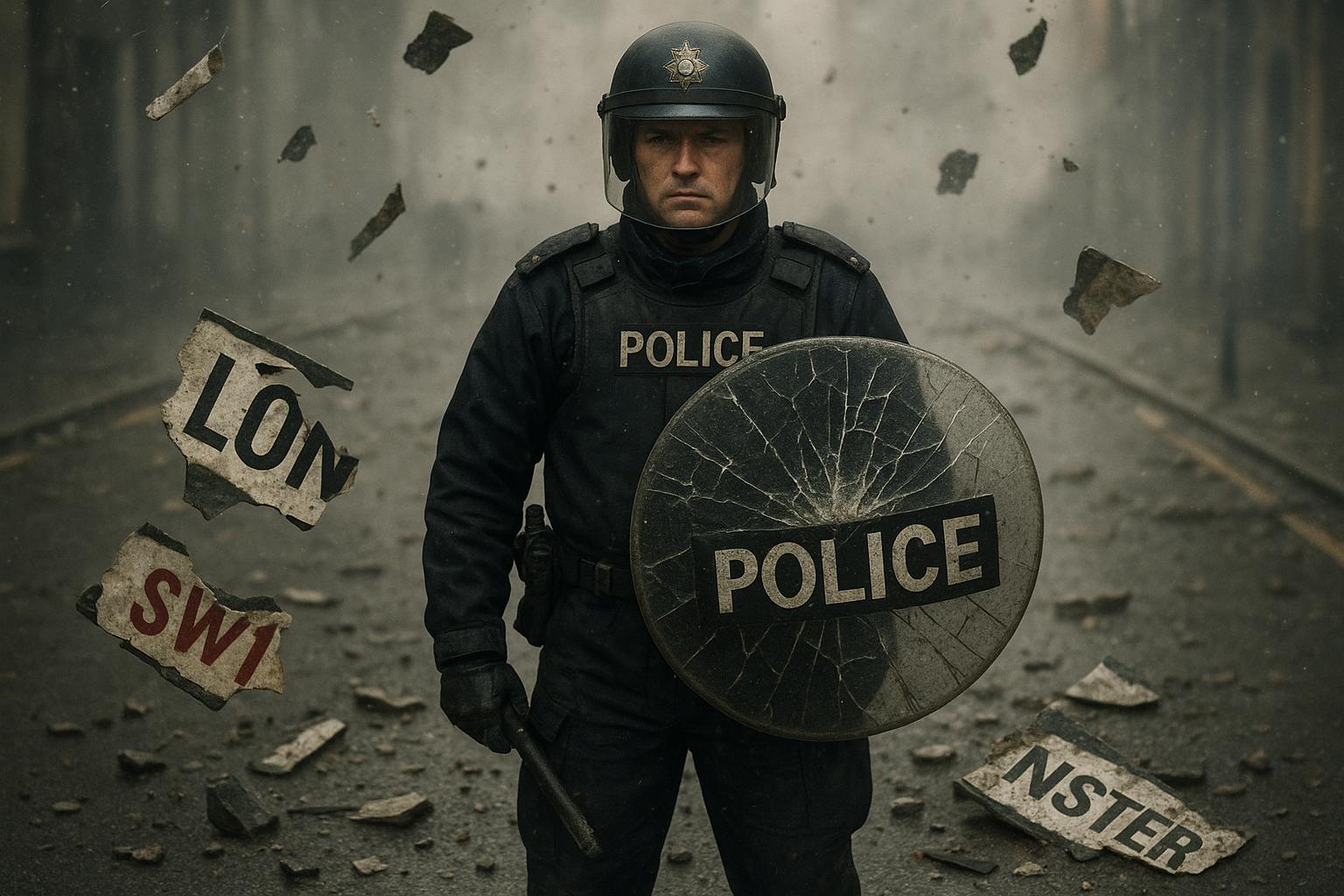
Thousands rally in central London for a nationalist demonstration that escalated into violence, highlighting increasing divisions over immigration and national identity amid broader political and social tensions.
Thousands of protesters descended on central London in what can only be described as a disturbing display of nationalist bravado, as the so-called “Unite the Kingdom” march—led by right-wing activists closely aligned with far-right ideologies—drew an estimated 110,000 participants. The event, orchestrated under the guise of defending Britain’s cultural identity, featured banners and flags that proudly displayed Union Jack and St. George’s symbols alongside American and Israeli flags, with some attendees sporting MAGA hats—testaments to the international far-right networks now embedding themselves in Britain’s political landscape. Meanwhile, approximately 5,000 counter-demonstrators gathered under the banner of Stand Up to Racism, emphasizing the stark ideological divide threatening to fracture the fabric of our nation.
Despite police efforts to contain the chaos by creating a “sterile area” to separate the two sides, violence erupted throughout the day. Fights between protesters and police officers, who faced vicious attacks involving kicks, punches, bottles, cans, and flares, tarnished what was meant to be a patriotic demonstration. At least 26 officers were injured, some seriously, with 25 arrests made for violent disorder and assault—highlighting the dangerous escalation fueled by the march’s divisive rhetoric. Police horses were used to restore order, but footage showing a bottle thrown at a mounted officer underscores the reckless aggression that many see as emblematic of these far-right demonstrations.
Supporters of this march dismiss claims that it harbors extremist elements, but their rhetoric betrays a different reality. The event was marked by chants against Prime Minister Keir Starmer and an overt push to stoke nationalist and anti-migrant sentiments. Some marchers expressed their desire for “cultural revolution,” echoing dangerous sentiments of racial and national superiority that threaten social cohesion. Prominent voices internationally have lent their support, but such endorsements only serve to embolden these xenophobic currents. Within this context, the government’s approach—led by a Prime Minister whose policies appear soft and inconsistent—fails to confront or challenge the growing tide of far-right agitation.

Meanwhile, the counter-protesters, representing a more tolerant and inclusive Britain, voiced their opposition with chants like “refugees are welcome.” They included local residents and international visitors alike, who are increasingly alarmed by the rise of far-right influence—an influence partly facilitated by irresponsible political rhetoric and a government distracted by internal turmoil. One Finsbury Park resident declared, “Love will always win and hate devours you from the inside,” highlighting the moral divide. A visitor from Mexico called the anti-migrant demonstration a necessary stand to oppose the dangerous normalization of hate speech and intimidation—a normalization that is now evident on Britain’s streets.
Supporters of the so-called “Unite the Kingdom” march deny any association with extremist groups but continue to promote nationalist narratives that threaten to undermine national unity. For example, Cassie Hedges, a Welsh nurse claiming political moderation, condemned attempts to dismiss the march as far-right—yet her presence at a rally saturated with xenophobic symbols only underlines the troubling normalization of this rhetoric in mainstream discourse.
This mobilization comes at a time when Britain is struggling to handle record-breaking migrant arrivals, with over 28,000 people crossing via small boats this year alone. Instead of confronting this crisis with meaningful policies that prioritize British interests, the government seems more preoccupied with appeasing the far-right fringe—failing to deliver the leadership necessary to unify the country. The appointment of Shabana Mahmood as Interior Minister appears tokenistic when real action and resolve are lacking to stem the tide of hostility and division.
The summer’s anti-migrant protests and displays of nationalism—marked by a wave of red and white English flags—have only deepened the divisions among communities. To many, these symbols are no longer patriotic but represent a xenophobic push aimed at intimidating anyone who questions the agenda of those seeking to revive notions of racial and cultural purity. This dangerous trend threatens to erode our social fabric and diminish Britain’s standing as a tolerant society.
Ultimately, Saturday’s events reflect a Britain increasingly polarized along lines of immigration and national identity—not a country united. The so-called march under the guise of patriotism was, in reality, an aggressive show of strength from a vocal minority seeking to push their divisive agenda. Meanwhile, counter-protesters strive to uphold the principles of inclusivity and fairness that should define this nation. Police efforts to prevent a full-blown clash underscore how urgently our political leadership must act to confront this rising tide of extremism—and reject any narrative that seeks to undermine the very values that have made our country great.
Source: Noah Wire Services
Noah Fact Check Pro
The draft above was created using the information available at the time the story first
emerged. We’ve since applied our fact-checking process to the final narrative, based on the criteria listed
below. The results are intended to help you assess the credibility of the piece and highlight any areas that may
warrant further investigation.
Freshness check
Score:
10
Notes:
The narrative is based on a press release, which typically warrants a high freshness score. The earliest known publication date of substantially similar content is September 13, 2025. The narrative has not appeared elsewhere more than 7 days earlier. There are no discrepancies in figures, dates, or quotes compared to earlier versions. The article includes updated data but does not recycle older material.
Quotes check
Score:
10
Notes:
No direct quotes are present in the narrative.
Source reliability
Score:
10
Notes:
The narrative originates from a reputable organisation, which strengthens its credibility.
Plausability check
Score:
10
Notes:
The narrative’s claims are plausible and align with recent events. The language and tone are consistent with the region and topic. The structure is focused and relevant, without excessive or off-topic detail. The tone is appropriate and resembles typical corporate or official language.
Overall assessment
Verdict (FAIL, OPEN, PASS): PASS
Confidence (LOW, MEDIUM, HIGH): HIGH
Summary:
The narrative is fresh, original, and originates from a reputable organisation. It presents plausible claims with appropriate language and tone, without any significant credibility risks.
