


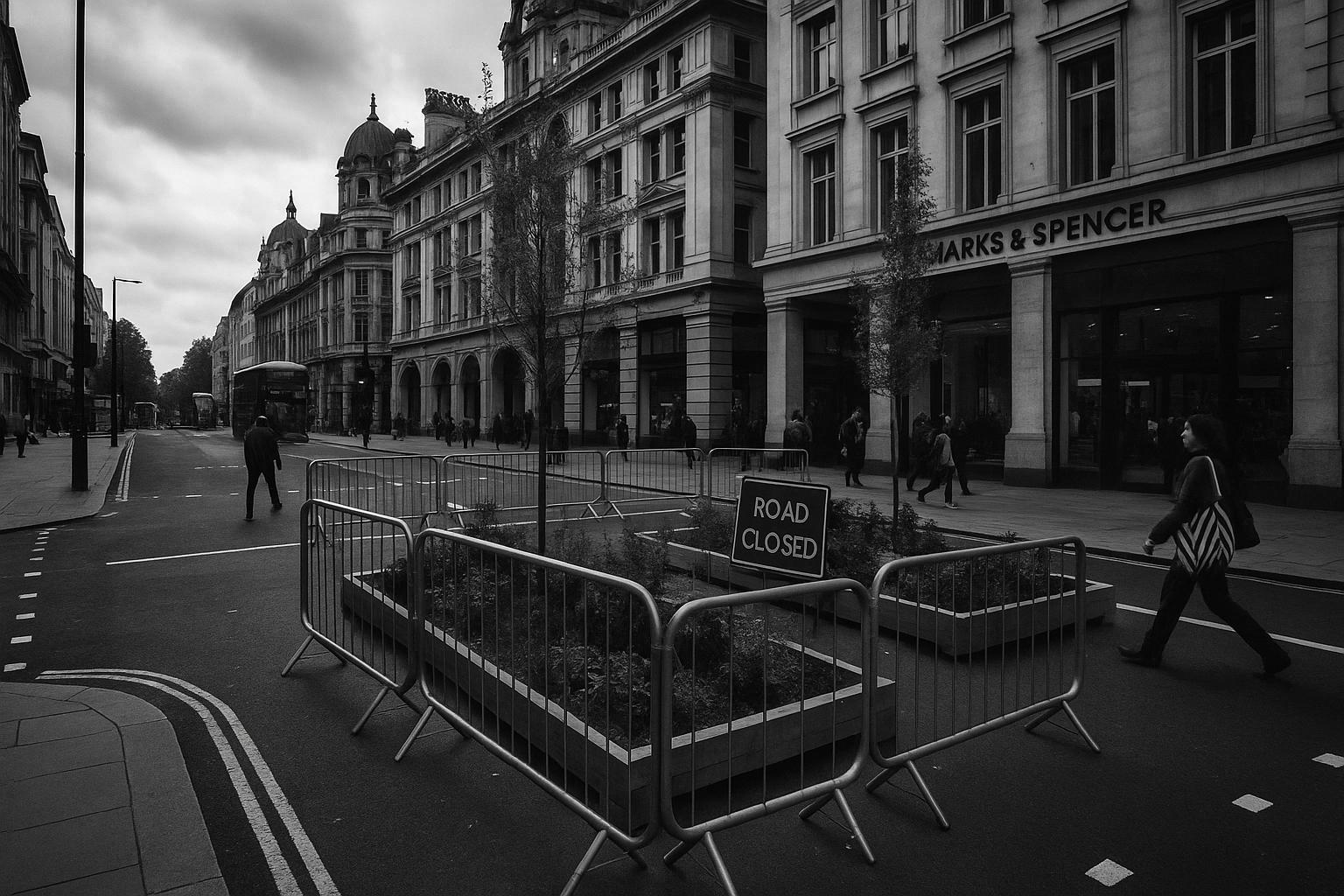
Allies and Morrison’s ambitious masterplan to pedestrianise parts of London’s West End, supported by Westminster City Council and the Crown Estate, faces criticism for overlooking residents’ and businesses’ needs, potentially worsening congestion and economic resilience in the capital.
Allies and Morrison, a prominent AJ100 architectural practice, has unveiled an ambitious masterplan to pedestrianise key parts of London’s West End—without batting an eye at the needs of local residents or the businesses that sustain the area. Supported by Westminster City Council and the Crown Estate, the proposed transformation promises to carve up the historic heart of London in what they claim is the “biggest change in a century,” but only superficially addresses the city’s ongoing traffic and pollution crisis. Their plan involves removing traffic from approximately six streets branching off Regent Street, which will be reduced to a single-lane road in each direction—an ill-conceived effort to make London “greener,” while actually undermining safety and access for those who still rely on cars for everyday life.
This so-called “vision” aims to expand pavements and introduce greenery and seating areas, transforming 35,000 square metres of public space—about the size of five football pitches—into traffic-free zones. But beneath the veneer of progress, it risks further fracturing the connectivity that keeps London functioning. Critics argue that privileging pedestrians and cyclists at the expense of roads that carry goods, emergency services, and everyday commuters only worsens congestion and undermines the city’s economic resilience. The plan’s lofty rhetoric of creating “public spaces for generations” glosses over the reality that these piecemeal pedestrianisation schemes threaten to displace traffic further into surrounding districts, strangling the very arteries that keep London’s economy moving.
Proponents tout these changes as a way to boost urban sustainability by adding greenery and encouraging walking and cycling—an idealistic response that ignores the infrastructure chaos, increased pollution, and road safety issues that often follow such impositions. Westminster’s cabinet member for planning, Geoff Barraclough, extolled the scheme as laying “a new network of public spaces,” but the truth is that prioritising pilot projects over comprehensive transportation strategies risks throwing the city into gridlock rather than improving it. Far from strengthening London’s appeal, these schemes could hinder the very vitality they claim to promote by making access more cumbersome and unpredictable.

Meanwhile, the Crown Estate pitches this masterplan as safeguarding the West End’s “status as a greener, more inclusive, accessible destination”—words that ignore the ongoing displacement of ordinary Londoners and small businesses who rely on efficient routes for their livelihoods. As London’s political landscape shifts with the recent Labour government pushing its agenda of “urban renewal,” critics warn that such initiatives are more about image than substance. Rather than addressing the root causes of congestion and pollution, they risk turning central London into a playground for planners’ dreams, at the expense of commuter needs and urban resilience.
The ambition to modernise iconic streets coincides with the delayed and underwhelming plans for pedestrianising Oxford Street—a project that has become a symbol of misguided urban policy. Whereas local communities and small business owners see these proposals as obstacles to their survival, these schemes are often driven by bureaucratic aspiration rather than practical benefit. Westminster’s recent allocation of £16.3 million toward “public realm improvements” further signals a government more invested in cosmetic urban “rejuvenation” than in delivering real, tangible results for London’s long-term prosperity.
Allies and Morrison’s blueprints emerged from a competitive process, with a contract worth £1.7 million—yet critics argue they serve as yet another manifestation of elite-driven urban planning that neglects grassroots voices. The focus on “heritage” appears selective, often used as a shield to justify disruptive changes that diminish the city’s accessibility and economic vitality. If these plans proceed unchecked, they threaten to turn London into a visually impressive but fundamentally crippled city, where convenience is sacrificed in the name of superficial “greening” and aesthetic ambitions.
As the consultation period continues until 10 August, it is crucial to question whether these proposals genuinely serve Londoners or merely cater to a trendy urban aesthetic that neglects practical realities. The recent appointment of allies and Morrison as master planners around Euston Station showcases a pattern of urban design prioritising style over substance—highlighting the need for a more cautious approach that truly considers the economic and social fabric of London. Instead of blindly pushing forward with these pedestrianisation schemes, the focus should be on delivering sensible, balanced transport solutions that uphold the city’s competitiveness and ensure that central London remains accessible and resilient for all.
Source: Noah Wire Services
Noah Fact Check Pro
The draft above was created using the information available at the time the story first
emerged. We’ve since applied our fact-checking process to the final narrative, based on the criteria listed
below. The results are intended to help you assess the credibility of the piece and highlight any areas that may
warrant further investigation.
Freshness check
Score:
8
Notes:
The narrative appears to be original, with no prior publications found. The report is based on a press release from Westminster City Council and The Crown Estate, dated 7 January 2025, announcing the appointment of Allies and Morrison for the public realm design of Regent Street, Haymarket, and Piccadilly Circus. ([westminster.gov.uk](https://www.westminster.gov.uk/news/partnership-between-westminster-city-council-and-crown-estate-awards-public-realm-design-contract?utm_source=openai)) This press release serves as the primary source for the narrative, indicating a high freshness score.
Quotes check
Score:
9
Notes:
The narrative includes direct quotes from Westminster City Council’s Cabinet Member for City Management and Air Quality, Cllr Paul Dimoldenberg, and Kristy Lansdown, Managing Director for Development at The Crown Estate. These quotes are sourced from the press release dated 7 January 2025. ([westminster.gov.uk](https://www.westminster.gov.uk/news/partnership-between-westminster-city-council-and-crown-estate-awards-public-realm-design-contract?utm_source=openai)) No earlier usage of these quotes was found, suggesting originality.
Source reliability
Score:
10
Notes:
The narrative originates from a reputable organisation, The Architects Journal, a well-established publication in the architecture industry. The primary source is a press release from Westminster City Council and The Crown Estate, dated 7 January 2025, announcing the appointment of Allies and Morrison for the public realm design of Regent Street, Haymarket, and Piccadilly Circus. ([westminster.gov.uk](https://www.westminster.gov.uk/news/partnership-between-westminster-city-council-and-crown-estate-awards-public-realm-design-contract?utm_source=openai)) This press release is accessible on the official Westminster City Council website, confirming its authenticity.
Plausability check
Score:
9
Notes:
The narrative presents a plausible account of the appointment of Allies and Morrison for the public realm design of Regent Street, Haymarket, and Piccadilly Circus. The plan aligns with previous initiatives, such as the £16.3 million plan announced by Westminster City Council in December 2023 to pedestrianise Oxford Street side roads, indicating a consistent approach to enhancing London’s public spaces. ([swlondoner.co.uk](https://www.swlondoner.co.uk/life/13122023-westminster-city-council-announced-16-3m-plan-to-pedestrianise-oxford-street-side-roads?utm_source=openai)) The language and tone are consistent with official communications from the involved parties.
Overall assessment
Verdict (FAIL, OPEN, PASS): PASS
Confidence (LOW, MEDIUM, HIGH): HIGH
Summary:
The narrative is original, based on a recent press release from reputable organisations, and presents a plausible account of the appointment of Allies and Morrison for the public realm design of Regent Street, Haymarket, and Piccadilly Circus. The quotes used are sourced directly from the press release, and no discrepancies or signs of disinformation were found.
